Equipment & Tools
Some of our tools and equipments.

Metal Lathe
For making gears and parts.
A metal lathe or metalworking lathe is a large class of lathes designed for precisely machining relatively hard materials. They were originally designed to machine metals; however, with the advent of plastics and other materials, and with their inherent versatility, they are used in a wide range of applications, and a broad range of materials. In machining jargon, where the larger context is already understood, they are usually simply called lathes, or else referred to by more-specific subtype names (toolroom lathe, turret lathe, etc.). These rigid machine tools remove material from a rotating workpiece via the (typically linear) movements of various cutting tools, such astool bits and drill bits.


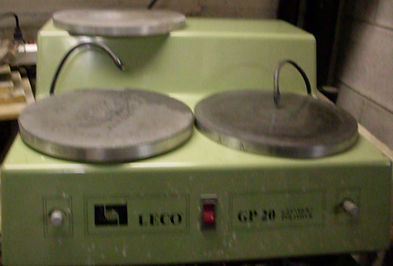
Glass Lapping & Polishing Machine
For bevelling and polishing glass.
Lapping is a machining process, in which two surfaces are rubbed together with an abrasive between them, by hand movement or by way of a machine.This can take two forms. The first type of lapping (traditionally called grinding), typically involves rubbing a brittle material such as glass against a surface such as iron or glass itself (also known as the "lap" or grinding tool) with an abrasive such as aluminum oxide, jeweller's rouge, optician's rouge, emery, silicon carbide, diamond, etc., in between them. This produces microscopicconchoidal fractures as the abrasive rolls about between the two surfaces and removes material from both.

Bench Grinder
For shaping and smoothing metal parts.
A bench grinder is a type of benchtop grinding machine used to drive abrasive wheels. A pedestal grinder is a larger version of a bench grinder that is mounted on a pedestal, which is bolted to the floor. These types of grinders are commonly used to hand grind cutting tools and perform other rough grinding.
Depending on the grade of the grinding wheel it may be used for sharpening cutting tools such as lathe tools or drill bits. Alternatively it may be used to roughly shape metal prior to welding or fitting.
A wire brush wheel or buffing wheels can be interchanged with the grinding wheels in order to clean or polish work-pieces.
Grinding wheels designed for steel should not be used for grinding softer metals, like aluminium. The soft metal gets lodged in the pores of the wheel and expand with the heat of grinding. This can dislodge pieces of the grinding wheel.


Small Benchtop Muffle Furnace
For heating and cooking parts.
Versatile and economical furnaces are specifically designed for ashing organic and inorganic samples, determining volatile and suspended solids, gravimetric analysis, heat treating of small steel parts, and ignition tests.
Reliable digital control ensures accurate temperature control. Turn the set point knob and the furnace automatically heats to selected temperature. Thermocouple break protection cuts power to the heating elements, preventing thermocouple failure and runaway condition.

Drill Press
For drilling straight holes into parts.
A drill press (also known as pedestal drill, pillar drill, or bench drill) is a fixed style of drill that may be mounted on a stand or bolted to the floor orworkbench. Portable models with a magnetic base grip the steel workpieces they drill. A drill press consists of a base, column (or pillar), table, spindle (or quill), and drill head, usually driven by an induction motor .

Height Gauges
For measuring and calibrating parts.
A height gauge is a measuring device used either for determining the height of something, or for repetitious marking of items to be worked on.These measuring tools are used in metalworking or metrology to either set or measure vertical distances; the pointer is sharpened to allow it to act as a scriber and assist in marking out work pieces.

Optical Microscope
For viewing and inspecting parts.
A modern microscope with a mercury bulb or fluorescence microscopy.


Sheet Metal Corner Notcher
For punching out bits of metal to shape parts.
Notching is a metal-cutting process used on sheetmetal or thin barstock, sometimes on angle sections or tube. A shearing or punching process is used in a press, so as to cut vertically down and perpendicular to the surface, working from the edge of a workpiece. Sometimes the goal is merely the notch itself, but usually this is a precursor to some other process: such as bending a corner in sheet or joining two tubes at a tee joint, notching one to fit closely to the other.Notching is a low-cost process, particularly for its low tooling costs with a small range of standard punches.